

Happy Healthy Content
4-Part eCourse: Stress Recovery
4-Part eCourse: Stress Recovery
Couldn't load pickup availability
Grab one of the limited copies of this new 4-part eCourse about Stress Recovery. It includes 4 reports, 4 checklists, 4 journals, 100 journal prompts, and 12 eCovers all for one low price.
What You Get:
- Part 1: Understanding Stress and Recovery
- Part 2: Creating Daily Recovery Practices
- Part 3: Emotional and Mental Stress Recovery
- Part 4: Sustaining Recovery Over Time
- 4 Checklists - Checklist for Each Part of Course (Editable in Canva)
- Journal Prompts - 100 Journal Prompts (25 for each part of the course)
- 4 Journals - Prompted Journals for the Course (Editable in Canva)
- eCovers - 8 eCovers for the Course (Editable in Canva)
Part 1: Understanding Stress and Recovery
9 pages, 2,504 words
How Stress Lives in the Body
Short-Term Stress Versus Chronic Stress
The Difference Between Coping and Recovery
Why Rest Alone Does Not Equal Recovery
Stress Accumulation Without Burnout
Recovery as a Biological Need
The Role of Safety in Stress Recovery
Setting Realistic Recovery Expectations
Part 2: Creating Daily Recovery Practices
9 pages, 2,143 words
Designing Low-Demand Mornings
Creating Recovery-Friendly Transitions
Daily Practices That Reduce Cognitive Load
Physical Ease as Daily Support
Emotional Check-Ins Without Processing
Environmental Adjustments That Support Recovery
Evening Habits That Support System Wind-Down
Building Consistency Without Rigidity
Part 3: Emotional and Mental Stress Recovery
9 pages, 1,978 words
Understanding Emotional Load
Mental Overload and Decision Fatigue
Emotional Labor and Recovery Depletion
Releasing the Need to Analyze Everything
Emotional Neutrality as a Recovery Phase
Reducing Internal Pressure and Self-Monitoring
Rebuilding Emotional Safety Internally
Mental Recovery Through Simplification
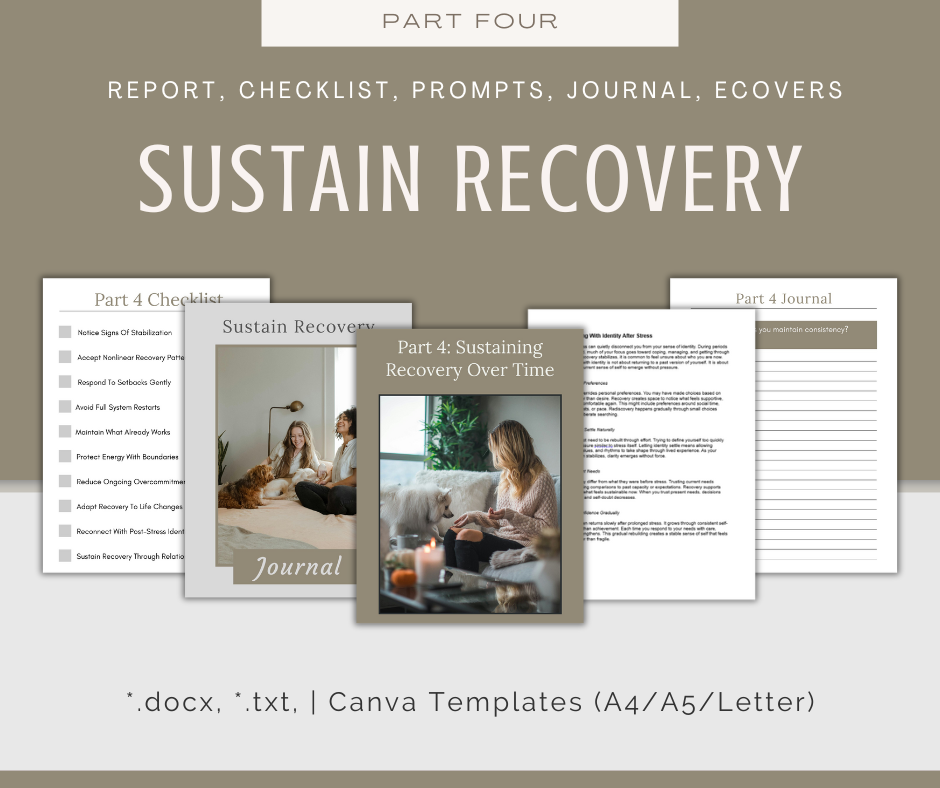
Part 4: Sustaining Recovery Over Time
9 pages, 1,904 words
Recognizing Signs of Stabilization
Allowing Recovery to Be Nonlinear
Responding to Setbacks Without Force
Avoiding the Restart Cycle
Protecting Recovery Through Boundaries
Adapting Recovery as Life Changes
Reconnecting With Identity After Stress
Long-Term Recovery as a Relationship
Each part of this ecourse also includes 25 journal prompts, a checklist, journal, and eCover.
Share